
Play Chicken road 2 Now!
Home → Auto Cashout
Chicken Road 2 Auto Cashout
Auto cashout in Chicken Road 2
InOut Games provides a built-in auto cashout feature for Chicken Road 2, allowing players to bypass manual reaction times during the rising multiplier phase. This automation closes the bet at a predefined threshold before the chicken hits, ensuring consistent execution regardless of network latency or user hesitation. The mechanic integrates directly with the game's provably fair algorithm without altering the underlying house edge of 4.50% established by the 95.50% RTP.
Chicken Road 2 round parameters
| Max multiplier | x3,608,855 |
| RTP | 95.50% |
| Bet range | $0.01 - $200 |
The maximum potential win of x3,608,855 on Hardcore difficulty requires precise timing, making automated exits essential for managing risk across thousands of rounds. Players can set this parameter within the $0.01 to $200 betting range, adjusting stake sizes while letting the software handle the critical moment of termination. This approach removes emotional decision-making from the equation, focusing purely on statistical probability and disciplined bankroll management strategies for long-term play.
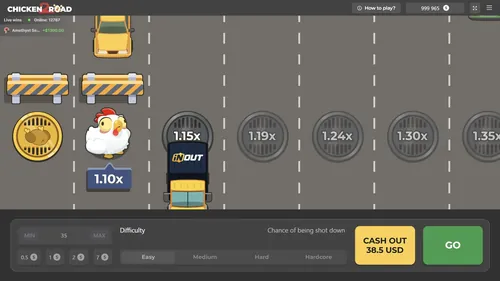
Setting a target multiplier
Chicken Road 2 offers four distinct difficulty levels that dictate the available lanes and corresponding multiplier caps, ranging from Easy up to x23.24 to Hardcore reaching x3,608,855. Selecting a lower tier like Medium with 25 lanes provides a higher probability of early cashouts but limits the maximum gain compared to the volatile Hardcore option. Users must choose their preferred risk profile before each round, as the lane count directly influences the speed at which the multiplier ascends toward the crash point.
Why automation removes hesitation
Hesitation causes losses when players wait too long for higher multipliers, risking the entire stake just before the inevitable crash event occurs in Chicken Road 2. Auto cashout eliminates this psychological barrier by executing trades based on pre-set logic rather than fleeting emotions or hope for bigger payouts during volatile phases. This discipline protects the player from the natural variance inherent in medium volatility games where outcomes can swing dramatically between small wins and total loss.
The theoretical return of 95.50% over hundreds of thousands of rounds relies on consistent application of strategy, which manual play often fails to maintain under pressure. By automating the exit point, players align their behavior with the mathematical expectation of InOut Games' engine, reducing the impact of human error on final results. This consistency is crucial for managing the 4.50% house edge effectively over extended sessions involving multiple bets across different difficulty settings.
Low targets versus high targets
Setting low cashout targets near the starting multiplier yields frequent but small profits, suitable for conservative players aiming to preserve capital within the $0.01 minimum bet limit. High targets on Hardcore mode chase the x3,608,855 cap, resulting in longer losing streaks before hitting a significant win due to the increased number of steps required. This trade-off defines the core strategic choice, balancing frequency of returns against the magnitude of individual payout events in every single round played.
Medium difficulty with 25 lanes offers a balanced middle ground, providing moderate multiplier growth up to x2,457 without the extreme volatility of the hardest setting. Players targeting these mid-range values experience fewer consecutive losses than those chasing maximum wins, yet still achieve substantial gains compared to the cautious Easy mode approach. Understanding these distinctions helps users select parameters that match their specific risk tolerance and financial goals when engaging with the game mechanics.
Auto bet alongside auto cashout
Combining auto bet with auto cashout creates a fully hands-free session where both the stake size and exit point are predetermined for each round in Chicken Road 2. This dual automation allows users to run thousands of cycles using the full $200 maximum bet range without requiring constant interaction or monitoring of the screen. It transforms the game into a statistical exercise, enabling precise control over total exposure and potential turnover while adhering to the provably fair standards set by InOut Games.
The welcome bonus of 300% up to €2,000 plus 100 free spins may impose wagering requirements that benefit from such efficient, automated gameplay structures to meet turnover targets quickly. Using auto features ensures that every eligible bet contributes consistently to clearing conditions without gaps caused by breaks or delayed actions during live sessions. This methodical approach maximizes the utility of promotional funds while maintaining strict adherence to the game's rules and maximum win constraints.
Chicken Road 2: key facts
| Parameter | Value |
|---|---|
| Game | Chicken Road 2 |
| Studio | InOut Games |
| Released | 2025 |
| RTP | 95.50% |
| House edge | 4.50% |
| Volatility | medium |
| Max win | x3,608,855 |
| Bet range | $0.01 – $200 |
Choosing a cashout target
InOut Games structures Chicken Road 2 around four distinct difficulty levels, each defining the lane count and potential multiplier cap for every round. The Easy mode offers thirty lanes with a maximum win of x23.24, providing a safer path for mobile players seeking smaller, more frequent returns on their bets.
The Hardcore difficulty presents eighteen lanes but allows a theoretical maximum win of x3,608,855, representing the highest risk tier available to users attempting to chase substantial payouts during a session. This extreme volatility requires precise timing as the chicken advances across fewer safe steps before the crash occurs unpredictably.
A bet range spanning from $0.01 to $200 accommodates various bankroll sizes, allowing players to adjust their stake size according to the chosen difficulty level without exceeding their limits. Fish Road by InOut Games offers a different risk profile with its RTP of 96.00%, but Chicken Road 2 remains distinct in its step-based crash mechanics.
Double bet setups
InOut Games designed Chicken Road 2 with a bet range of $0.01 to $200, allowing players to split funds across multiple active lanes during a single round. This flexibility supports the medium volatility structure by enabling varied exposure levels without altering the underlying mathematical model or the fixed house edge of 4.50%. Players can allocate specific amounts to different difficulty tiers, such as Easy or Hardcore, to balance risk against potential returns within one session.
The maximum win cap stands at x3,608,855 for the Hardcore level, which offers only 18 lanes compared to the 30 lanes available in the Easy setting. By placing two simultaneous bets on distinct difficulty modes, users might secure small frequent payouts from easier paths while chasing the massive top prize on harder routes. This dual approach does not change the theoretical RTP of 95.50% but allows for more dynamic bankroll management strategies across different game speeds.
Rabbit Road, also developed by InOut Games, shares the same RTP and max win potential but lacks the explicit lane-based difficulty menu found in Chicken Road 2. Using a double bet setup here requires careful monitoring of the auto cashout settings to ensure both wagers trigger before the multiplier crashes unexpectedly. The provably fair mechanism guarantees that each crash point is generated independently, ensuring that splitting stakes does not introduce bias into either outcome.
Splitting stakes across two bets
A player can divide a single deposit into two separate wagering actions within the same round, utilizing the auto mode to handle execution speed precisely. With a minimum stake of $0.01 and a maximum of $200, dividing a $100 budget into two $50 bets allows for concurrent targeting of different multiplier thresholds. This method leverages the instant nature of the crash mechanic, where reaction time is replaced by pre-set parameters defined before the round begins.
The medium volatility rating suggests that wins occur with moderate frequency, making it feasible to sustain two parallel betting lines over an extended period. If one bet fails due to an early crash, the other might succeed if it targets a lower multiplier on a higher-lane difficulty setting like Medium. This strategy relies on the independence of each lane's path, though the overall return remains capped by the 95.50% theoretical RTP over thousands of rounds.
Unlike Rabbit Road, which operates under similar statistical constraints, Chicken Road 2 provides four distinct difficulty levels that allow for granular stake distribution across varying risk profiles. Splitting stakes between Easy and Hard modes creates a hybrid experience where low-risk recovery attempts are paired with high-risk accumulation phases. The provably fair system ensures that neither the studio nor the player can predict the exact moment the chicken crosses the road, maintaining integrity in all split scenarios.
Combining a safe and a risky target
Combining a safe cashout at a low multiplier with a risky hold on a high multiplier utilizes the full range of the game's difficulty settings effectively. A player might set an auto cashout at x2 on the Easy tier, which offers 30 lanes, while letting another bet ride on the Hardcore tier with just 18 lanes. This dual-target approach aims to cover losses from the risky bet with steady gains from the safe bet, aligning with the medium volatility profile of the title.
The house edge of 4.50% applies equally to both the conservative and aggressive portions of the combined bet, meaning long-term profitability remains statistically unlikely regardless of the split ratio. However, the psychological benefit of securing partial wins from the safe target can help manage bankroll depletion during losing streaks common in crash games. The maximum win of x3,608,855 remains accessible only through the risky component, as the safe target caps earnings significantly below this threshold.
In comparison to Rabbit Road, where the mechanics are nearly identical, Chicken Road 2's explicit lane counts provide clearer visual feedback on probability density for each difficulty level. Setting a safe target on the Easy mode reduces variance because more lanes imply a slower average multiplier growth, whereas the Hardcore mode demands patience for larger multipliers. This combination requires precise timing via the auto cashout feature to prevent the risky bet from crashing before reaching its intended profit zone.
Limits of any automated plan
Auto cashout closes a bet automatically at a chosen multiplier, removing human reaction time from the outcome but not changing the built-in 4.50% house edge. Even with perfect automation, the random number generator determines the crash point independently for each round, meaning no algorithm can guarantee consistent profits over time. Players using the $0.01 to $200 bet range must accept that volatility will cause significant swings in their bankroll despite strict adherence to predefined exit strategies.
Theoretical RTP of 95.50% indicates that for every $100 wagered, approximately $95 is returned to players over hundreds of thousands of spins, leaving $5 as the casino advantage. Automated plans cannot alter this mathematical reality, as the game's logic is hard-coded into the server-side software managed by InOut Games. Users relying solely on automation may experience rapid depletion of funds during periods of bad luck, which are inevitable in any crash game environment.
While Rabbit Road shares the same developer and RTP, Chicken Road 2's unique lane structure adds a layer of strategic depth that automation cannot fully exploit. An automated plan might miss opportunities to adjust stakes based on recent loss patterns, as the game does not offer adaptive betting features beyond simple fixed multipliers. The provably fair system ensures transparency, but it does not provide any insight into future outcomes, rendering predictive automation ineffective for beating the edge.
What automation cannot fix
No software tool can overcome the fundamental disadvantage imposed by the 4.50% house edge embedded in the 95.50% RTP of Chicken Road 2. Automation simply executes pre-defined instructions faster than manual play, but it cannot influence the random crash point generated by the provably fair algorithm used by InOut Games. Players should recognize that speed of execution does not equate to improved odds, as each round remains an independent event with fixed probabilities.
The maximum win of x3,608,855 is a statistical outlier rather than an achievable goal for most automated systems, which typically aim for smaller, more frequent payouts. Attempting to automate high-multiplier targets often leads to rapid bankroll exhaustion due to the low probability of hitting those extreme values on the Hardcore difficulty. This limitation highlights why responsible gambling practices are essential, as automation can accelerate losses just as quickly as it processes winning bets.
Unlike traditional slots, this crash game lacks reels or paylines, meaning there are no physical symbols landing to create illusions of near misses or hot streaks. Automation cannot fix the fact that the game is purely based on numerical chance, where past results have no bearing on future outcomes. Players relying on automated plans must understand that the medium volatility design ensures occasional large losses, regardless of how sophisticated the cashout strategy appears.
DemoRTP & VolatilityHow to PlayAuto CashoutStrategyBonusesMobileDownload & AppMax WinSimilar GamesReviewFAQSitemap
Chicken road 2 2026