
Play Chicken road 2 Now!
Home → Strategy
Chicken Road 2 Strategy
Approaching Chicken Road 2 sensibly
InOut Games released Chicken Road 2 in 2025 as a crash title, meaning the round consists of a single rising multiplier rather than spinning reels or landing paylines. This structural difference eliminates traditional slot mechanics and replaces them with a timing-based cash-out decision that defines every session. Players must understand that volatility here measures the risk of the chicken being hit before the withdrawal occurs. The absence of spins means bankroll management relies on predicting the crash point rather than counting rotations.
The theoretical return to player sits at 95.50%, establishing a house edge of 4.50% over extended play periods. This percentage indicates that for every €100 wagered across hundreds of thousands of rounds, the game retains €4.50 for the operator. Such a margin is standard for instant games but requires strict discipline to maintain long-term sustainability. Comparing this to the original Chicken Road by InOut Games reveals a lower RTP of 98.00%, highlighting why players might prefer the sequel despite its higher cost of play.
Common systems and their limits
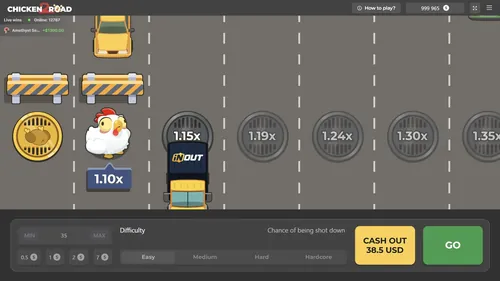
InOut Games released Chicken Road 2 in 2025 as a step-based crash game featuring four distinct difficulty levels. The Hardcore mode offers 18 lanes with a maximum potential win of x3,608,855, contrasting sharply with the Easy mode's upper limit of x23.24. This structural variance dictates that no single betting strategy can effectively cover all risk profiles simultaneously.
The theoretical return to player stands at 95.50%, establishing a house edge of 4.50% across all gameplay variants. In comparison, the related title Fish Road from the same studio provides an RTP of 96.00% alongside a max win cap of x2,542,251.93. Players seeking higher long-term returns must recognize that Chicken Road 2 carries a slightly higher built-in mathematical disadvantage.
Flat betting explained
Flat betting requires the player to wager the identical stake amount during every single round of play. With the minimum bet set at $0.01 and the maximum allowed at $200, this approach maintains a constant exposure to the 4.50% house edge. Consistency in staking prevents rapid bankroll depletion compared to fluctuating wager patterns.
The volatility is classified as medium, meaning outcomes distribute relatively evenly without extreme frequency of total loss. A player risking $1 per round faces a predictable erosion rate over thousands of rounds due to the fixed mathematical expectation. This stability allows for extended session durations without requiring complex stake adjustments or emotional decision-making.
Progressive staking risks
Progressive staking involves raising the stake size after a loss, aiming to recover previous deficits through larger subsequent bets. This method does not alter the inherent 4.50% house edge present in the game mechanics. Mathematical models confirm that such strategies only accelerate the time required to exhaust the available bankroll.
The maximum win potential of x3,608,855 appears attractive but remains inaccessible when stakes escalate uncontrollably during losing streaks. Unlike flat betting, which preserves capital, aggressive progression exposes the player to table limits and personal financial caps. The Provably Fair system ensures each round is independent, rendering past losses irrelevant to future multipliers.
What the maths actually allows
The RTP of 95.50% represents a theoretical average calculated over hundreds of thousands of rounds rather than a short-term guarantee. This figure implies that for every $100 wagered, the system returns approximately $95.50 to players collectively over infinite time. Individual sessions will inevitably deviate significantly from this mean due to random variance.
InOut Games utilizes a Provably Fair algorithm to verify the integrity of each crash point before the round concludes. This transparency allows players to audit the randomness of the multiplier curve independently of the casino server. Such verification ensures that the stated volatility and return percentages are executed exactly as programmed.
Chicken Road 2: key facts
| Parameter | Value |
|---|---|
| Game | Chicken Road 2 |
| Studio | InOut Games |
| Released | 2025 |
| RTP | 95.50% |
| House edge | 4.50% |
| Volatility | medium |
| Max win | x3,608,855 |
| Bet range | $0.01 – $200 |
Reading variance honestly
Variance in Chicken Road 2 describes the statistical dispersion of results around the expected return of 95.50%. High-variance modes like Hardcore exhibit wider swings between small wins and catastrophic losses compared to Low-risk Easy settings. Understanding this distribution helps players align their bankroll size with their tolerance for drawdown periods.
The auto mode feature allows users to preset cash-out targets, reducing emotional interference during high-variance stretches. However, automated execution cannot mitigate the fundamental risk imposed by the 4.50% house edge on every transaction. Players must accept that negative variance is a standard component of crash game mathematics.
Learning the game in demo first
InOut Games developed Chicken Road 2 as a crash title with a theoretical return of 95.50% across its four difficulty tiers, meaning players face a 4.50% house edge over millions of rounds rather than single spins. Understanding this mathematical baseline helps newcomers grasp why consistent winning is statistically impossible regardless of their chosen lane or cash-out timing during any given session. Players should recognize that the medium volatility ensures frequent small payouts alongside rare large multipliers, requiring patience and disciplined bankroll management to survive extended losing streaks without emotional decision-making.
The maximum potential win reaches x3,608,855 on the Hardcore mode with only eighteen lanes, while Easy mode caps at x23.24 across thirty lanes, offering vastly different risk profiles for new users testing their strategies. This stark contrast in multiplier limits demonstrates how selecting harder difficulties dramatically increases variance, potentially draining a modest bankroll quickly if the player fails to cash out before the chicken crosses the road unexpectedly. Beginners are advised to start with lower stakes to observe how provably fair algorithms determine outcomes without relying on superstition or flawed betting systems that claim to predict random crashes accurately.
Adjusting stakes to your budget
Chicken Road 2 allows bets ranging from $0.01 to $200 per round, giving players precise control over their exposure while maintaining access to high-limit action if their financial situation permits such aggressive wagering levels. Setting a fixed daily loss limit based on this range ensures that even consecutive failures cannot deplete essential funds, as the flat betting approach prevents chasing losses through progressive staking methods that typically accelerate ruin rates significantly faster than planned budgets allow.
Rabbit Road by InOut Games shares the same 95.50% RTP and identical max win cap of x3,608,855, yet offers distinct lane configurations that might influence stake sizing decisions when comparing similar titles within the studio portfolio. Players managing tight budgets often prefer starting at the minimum $0.01 bet to extend playtime across hundreds of rounds, whereas those seeking larger swings might allocate up to $200 per attempt despite the increased probability of rapid bankroll depletion due to higher variance exposure.
Recognising a bad session
A session becomes problematic when cumulative losses exceed twenty percent of the initial bankroll within two hours of continuous play, indicating that the 4.50% house edge is extracting capital faster than expected variance can provide recovery opportunities through lucky multipliers. Monitoring this threshold requires tracking total wagers against remaining funds, ensuring that players do not fall into the trap of increasing stakes after defeats because progressive staking never alters the built-in mathematical advantage held by the casino over time.
Stopping while ahead
Cashing out before the chicken gets hit defines success in Chicken Road 2, where locking in profits at multipliers like x23.24 on Easy mode preserves gains more reliably than chasing the elusive x3,608,855 jackpot on Hardcore settings. Establishing a profit target equal to fifty percent of the starting bankroll encourages disciplined withdrawal habits, preventing greed from overriding rational strategy when temporary wins create false confidence about future predictability or skill-based control over inherently random crash points determined by provably fair algorithms.
Responsible play in practice
Auto mode features in Chicken Road 2 help enforce predetermined cash-out rules, reducing impulsive decisions that often lead to substantial financial harm when players ignore established limits during emotionally charged gaming sessions. Utilizing these automated safeguards alongside strict deposit caps ensures that entertainment remains contained within affordable boundaries, protecting individuals from the psychological distortions caused by near-misses and reinforcing the reality that no betting system can overcome the fundamental 95.50% return rate over extended periods of actual gameplay involving thousands of independent rounds.
DemoRTP & VolatilityHow to PlayAuto CashoutStrategyBonusesMobileDownload & AppMax WinSimilar GamesReviewFAQSitemap
Chicken road 2 2026