
Play Chicken road 2 Now!
Home → Similar Games
Games Similar to Chicken Road 2
Games close to Chicken Road 2
Chicken Road 2 presents a crash mechanic with a maximum win of x3,608,855 across its four difficulty tiers. This ceiling matches the theoretical limit of Rabbit Road, another InOut Games title sharing the same mathematical structure. The identical payout cap confirms that high-variance road-crossing games often utilize comparable risk-reward frameworks for top-tier multipliers.
The game operates on a rising multiplier curve where players must cash out before the chicken is hit, avoiding the crash entirely. Aviator by Spribe employs a similar exponential growth pattern but features an RTP of 97.00% against Chicken Road 2's 95.50%. This one-point difference in return-to-player percentage highlights the trade-off between higher potential returns and increased house edge in instant play.
Easy mode offers up to x23.24 across thirty lanes, providing a gentler introduction to the step-based progression system. Fish Road allows wagers up to its own maximum win threshold of x2,542,251.93, which is lower than the highest tier of Chicken Road 2. Players seeking a slightly less volatile experience might compare the lane counts and multiplier caps across these distinct road-themed titles.
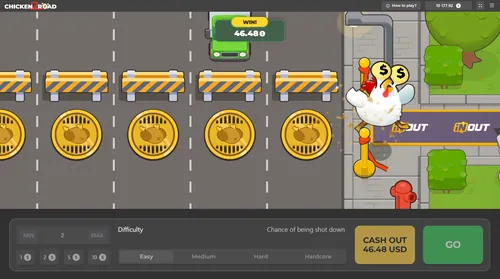
Titles with similar maths
Rabbit Road shares an exact RTP of 95.50% with Chicken Road 2, indicating identical long-term theoretical returns over hundreds of thousands of rounds. Both games originate from InOut Games and utilize a provably fair algorithm to verify round integrity. The matching return figures suggest that studio-specific mathematical models dictate the baseline house edge rather than the specific theme.
Hardcore mode scales the multiplier potential up to x3,608,855, representing the extreme end of the volatility spectrum within this genre. Tower Rush by Galaxsys caps wins at a modest 100x, demonstrating a fundamentally different mathematical approach to risk management. The vast disparity between these ceilings illustrates how crash games can range from low-risk stability to extreme high-stakes speculation.
Mines maintains a stable RTP of 97.00%, offering a higher theoretical return than the 95.50% found in Chicken Road 2. This three-percent advantage reduces the house edge significantly compared to the road-crossing mechanics of the primary title. Players analyzing mathematical efficiency will note that Mines provides better expected value retention despite differing gameplay structures.
Aviator delivers an RTP of 97.00% with a maximum win cap of x1,000,000, positioning it as a more conservative option than the hardcore tiers of Chicken Road 2. The lower maximum win limit contrasts sharply with the x3,608,855 potential available in the most difficult lanes of the main game. This comparison underscores the variance differences between widely popular crash games and niche sequels.
Same studio alternatives
InOut Games developed both Chicken Road 2 and its predecessor, Chicken Road, which boasts a superior RTP of 98.00%. The sequel introduces medium volatility with a 95.50% return, marking a deliberate shift toward higher risk compared to the original release. This adjustment allows for larger max wins while reducing the overall theoretical payback percentage for the player base.
Fish Road remains another product from InOut Games, featuring an RTP of 96.00% and a maximum win of x2,542,251.93. These metrics sit between the higher return of the original Chicken Road and the enhanced volatility of the new sequel. The consistent development style ensures that fans of the studio recognize familiar interface elements and provably fair verification systems across all titles.
Rabbit Road completes the core InOut Games portfolio mentioned here, mirroring Chicken Road 2 with an RTP of 95.50% and a max win of x3,608,855. The identical mathematical profile suggests parallel development tracks aimed at capturing the high-variance segment of the crash game market. Players exploring the studio's catalog will find multiple options with matching return figures but distinct thematic presentations.
The developer applies a uniform technical framework across these releases, ensuring provably fair outcomes through cryptographic verification. This standardization allows players to transfer their trust in the audit process from one title to another without recalibration. The consistent implementation of fairness protocols is a key characteristic linking all games produced by this specific studio.
Comparable volatility
Chicken Road 2 is classified as having medium volatility, balancing the frequency of smaller wins against the rarity of massive payouts. This classification aligns with the risk profile of Rabbit Road, which shares the same 95.50% RTP and max win potential. Players expecting steady engagement with occasional high-multiplier opportunities will find this variance level suitable for extended sessions.
Hardcore mode pushes the volatility into extreme territory by unlocking up to x3,608,855 across eighteen challenging lanes. This setup creates a stark contrast with Easy mode, which limits wins to x23.24 across thirty accessible lanes. The choice between these modes directly dictates the risk exposure, allowing players to tailor their session volatility to their bankroll size.
Tower Rush exhibits significantly lower volatility due to its strict maximum win cap of 100x, regardless of the bet size. This limitation prevents the extreme swings associated with the x3,608,855 potential found in the hardest lanes of Chicken Road 2. Comparing these caps reveals how volatility definitions vary when comparing games with capped versus uncapped or semi-capped win potentials.
The medium volatility rating implies a house edge of 4.50%, derived from the 95.50% theoretical return rate. This edge is higher than the 2.00% edge found in Aviator or Mines, reflecting the increased risk taken by players chasing larger multipliers. Understanding this relationship helps players manage expectations regarding the frequency and size of payouts during play.
Comparable return figures
Chicken Road 2 offers a theoretical RTP of 95.50%, resulting in a house edge of 4.50% over the long term. This figure is identical to the return rate of Rabbit Road, confirming that both games are mathematically aligned in their payout structure. Players analyzing the data will see that the studio maintains consistency in return percentages across similar difficulty settings.
Fish Road provides a slightly better RTP of 96.00%, reducing the house edge to 4.00% compared to the 4.50% of Chicken Road 2. This one-point improvement represents a measurable difference in expected value for high-volume players over thousands of rounds. The distinction highlights how minor adjustments in game design can impact the long-term financial outcome for the participant.
Aviator and Mines both feature an RTP of 97.00%, offering a house edge of only 3.00% against the 4.50% of the main title. This two-percent gap signifies a substantial advantage for players choosing these alternatives over Chicken Road 2 in terms of retention. The comparison demonstrates that not all crash games offer equal theoretical returns, making RTP a critical selection criterion.
The welcome bonus of 300% up to €2,000 plus 100 free spins applies to deposits but requires separate wagering compliance. While the bonus funds enhance initial bankroll capacity, the underlying game RTP determines the speed at which any winnings are retained. Players must consider both the promotional value and the inherent 95.50% return of Chicken Road 2 when evaluating total expected value.
Chicken Road 2 compared with similar titles
| Game | Studio | RTP | Volatility | Max win |
|---|---|---|---|---|
| Chicken Road 2 | InOut Games | 95.50% | medium | x3,608,855 |
| Tower Rush | Galaxsys | 97.00% | — | 100x |
| Chicken Road | InOut Games | 98.00% | — | x3,608,855 |
| Fish Road | InOut Games | 96.00% | — | x2,542,251.93 |
| Aviator | Spribe | 97.00% | — | x1,000,000 |
| Rabbit Road | InOut Games | 95.50% | — | x3,608,855 |
| Mines | — | 97.00% | — | — |
How these titles differ
Chicken Road 2 by InOut Games operates as a step-based crash game where players must cash out before the multiplier ends, offering four distinct difficulty levels with lane counts ranging from 18 to 30. This structural difference separates it from reel-based slots like Fortune Rabbit, which utilizes a non-standard 3-4-3 row grid and traditional spin mechanics rather than a rising multiplier curve. The absence of paylines in Chicken Road 2 means outcomes depend entirely on timing decisions rather than symbol alignment across defined lines.
Dice from Spribe allows adjustable volatility settings alongside a 97.00% RTP, providing players with direct control over risk profiles that Chicken Road 2 does not offer within its fixed difficulty tiers. While Chicken Road 2 maintains a consistent 95.50% theoretical return across all modes, Spribe’s Dice enables users to toggle between high and low variance strategies during active play sessions. This flexibility contrasts with the static mathematical model inherent to the chicken crossing mechanic found in the InOut Games title.
Plinko shares the instant-game classification with Chicken Road 2 but relies on ball-drop physics rather than a linear progression system, featuring a 97.00% RTP that exceeds the 4.50% house edge present in the chicken-themed variant. Unlike the deterministic lane structure of Chicken Road 2, Plinko introduces randomness through physical ball trajectories without adjustable difficulty parameters or provably fair step verification. Players seeking predictable risk management may find the fixed lane approach of the InOut Games release more transparent than the chaotic drop mechanics of other crash titles.
Feature sets side by side
Chicken Road 2 includes an auto mode feature that automates betting sequences while retaining the core requirement for manual intervention at each cash-out stage to secure winnings. This hybrid automation differs significantly from fully automated systems found in some instant games, as the player must still make critical timing decisions to avoid losing the stake when the chicken is hit. The integration of provably fair technology ensures every round outcome can be independently verified, adding a layer of transparency absent in many comparable market offerings.
The maximum win potential of x3,608,855 in Hardcore mode dwarfs the 5000x cap offered by Spaceman from Pragmatic Play, highlighting the extreme upside available in higher difficulty tiers of the chicken road series. While Spaceman provides a high-volatility experience with a 96.50% RTP, Chicken Road 2 achieves superior payout ceilings through its specific lane reduction mechanics that escalate multipliers exponentially. This stark contrast in winning limits demonstrates how difficulty scaling directly impacts the financial ceiling of a single successful round.
Fortune Rabbit from PG Soft features medium volatility and a 5000x max win, contrasting sharply with the Hardcore tier of Chicken Road 2 which offers up to x3,608,855 despite sharing similar medium-risk characteristics in lower modes. The structural divergence means players pursuing massive jackpots will find the lane-based crash mechanic far more lucrative than the reel-spinning format of the rabbit-themed slot. Such disparities underscore why understanding the specific feature set of each title is essential for aligning gameplay with personal risk tolerance and profit expectations.
Payout ceilings compared
The absolute maximum win in Chicken Road 2 reaches x3,608,855 in the Hardcore difficulty setting, representing the highest potential payout among the compared instant games listed in this analysis. This figure stands in direct opposition to the 20,659x cap found in Chicken Dash by TaDa Gaming, illustrating the vast range of reward structures available within the broader crash game category. Players targeting life-changing sums must navigate the reduced lane count of 18 in Hardcore mode to access this exceptional multiplier ceiling.
Easy mode in Chicken Road 2 caps at x23.24, which remains substantially lower than the 5000x maximum win achievable in both Spaceman and Fortune Rabbit releases. This tiered structure allows casual players to engage with minimal risk while accepting modest returns, unlike the uniform high-volatility design of Spribe’s Plane Game which lacks such graduated difficulty options. The progression from Easy to Hardcore thus serves as a risk-management tool rather than a simple theme variation, directly correlating lane density with potential reward size.
Medium difficulty offers a ceiling of x2,457, bridging the gap between the conservative Easy mode and the extreme Hardcore tier while maintaining the same 95.50% theoretical return rate across all levels. This middle ground provides a balanced alternative for players who find the 62,162x limit of Hard mode too volatile but consider the 20,659x cap of Chicken Dash insufficient for their strategy. Understanding these specific thresholds helps players select the appropriate risk profile without inadvertently exposing themselves to unintended loss levels.
Bet ranges compared
Chicken Road 2 supports a bet range from $0.01 to $200 per round, accommodating both micro-stakes players and high rollers within a single unified interface. This wide span allows for flexible bankroll management strategies that are less common in niche instant games with narrower wagering constraints. The minimum entry point of one cent makes the game accessible to casual users, while the two-hundred-dollar maximum caters to those seeking significant exposure per decision.
The upper limit of $200 in Chicken Road 2 contrasts with typical restrictions in standard slot games where maximum bets often hover around $100 or less depending on the provider. This elevated cap enables high-volume testing of the 95.50% RTP over shorter periods, though it simultaneously increases the rate of capital depletion during losing streaks. Players utilizing the auto mode feature can leverage this range to execute complex betting progressions without manually adjusting stakes after every round.
Spribe’s Dice and Plane Game generally operate within similar high-limit frameworks, allowing substantial wagers that align with the aggressive nature of crash-style gameplay. However, the precise $0.01 floor in Chicken Road 2 provides finer granularity for small-bankroll testing compared to some competitors that start at higher minimums like $0.10 or $0.20. This precision supports disciplined money management practices by allowing players to define exact risk percentages relative to their total balance.
Which suits which player
Players preferring structured risk management will appreciate the four distinct difficulty levels in Chicken Road 2, which allow explicit selection of volatility through lane count rather than abstract settings. This transparency appeals to analytical gamers who want to calculate expected value based on known variables like the 95.50% RTP and specific multiplier curves. The provably fair mechanism further satisfies this demographic by providing cryptographic proof of round integrity independent of casino trustworthiness.
High-rollers seeking massive payouts will gravitate toward the Hardcore mode’s x3,608,855 ceiling, accepting the increased probability of early elimination due to the reduced 18-lane configuration. This appeal mirrors the motivation behind playing high-volatility slots like Fortune Rabbit, though the mechanic here relies on timing rather than random symbol distribution. The ability to wager up to $200 per round amplifies the financial impact of each successful cash-out, justifying the higher risk tolerance required for this tier.
Casual users benefiting from the 300% welcome bonus up to €2,000 plus 100 free spins may find the Easy mode’s x23.24 cap sufficient for extended entertainment with lower stress levels. The straightforward cash-out mechanic requires no complex strategy beyond recognizing when to secure profits before the chicken is hit, making it ideal for beginners unfamiliar with crash game dynamics. This accessibility ensures that new players can engage with the 95.50% RTP environment without being overwhelmed by intricate rules or excessive volatility.
Trying alternatives in demo
Chicken Road 2 from InOut Games offers a theoretical RTP of 95.50%, which defines the long-term return expectation for players engaging with this specific crash mechanic across millions of rounds. This percentage indicates that the operator retains a house edge of 4.50% over an extended period, establishing the baseline mathematical expectation before any individual session begins or concludes. Players must recognize that this figure represents a statistical average rather than a guarantee for short-term play, meaning actual results will vary significantly from the projected return. The medium volatility further influences how often these returns materialize during typical gameplay sessions.
Rabbit Road by InOut Games presents an identical RTP of 95.50%, allowing users to compare the exact same theoretical return structure while testing different game mechanics on mobile devices. Comparing these two titles reveals that the studio maintains consistent mathematical models across its road-themed series, ensuring that bankroll management strategies remain applicable regardless of the chosen character. This parity enables analysts to evaluate platform stability without introducing variable return rates into the comparison framework used for evaluating mobile performance and user interface responsiveness. The max win cap also matches at x3,608,855 for both titles.
Fish Road provides a slightly higher RTP of 96.00% from InOut Games, offering a 0.50% advantage over Chicken Road 2 for players seeking marginally better long-term value on their deposits. This difference accumulates to roughly five euros saved per thousand euros wagered, highlighting why informed gamblers might switch between InOut Games titles based on subtle RTP variations. Testing Fish Road allows users to experience the same intuitive mobile controls while benefiting from the improved return percentage, making it a logical alternative for those optimizing their expected loss rate.
The maximum win potential reaches x3,608,855 in Chicken Road 2, creating a high-risk environment where players must decide precisely when to cash out before the multiplier collapses during each round. This extreme ceiling requires disciplined betting limits, as the probability of reaching such heights is extremely low despite the attractive payout structure advertised prominently on the game interface. Mobile users benefit from quick load times that allow them to react instantly to multiplier changes, ensuring they do not miss critical cash-out windows due to device latency issues.
Why variety helps bankroll
Chicken Road 2 features a bet range from $0.01 to $200, providing substantial flexibility for players adjusting their stake sizes according to their current bankroll balance and risk tolerance levels. Lower stakes allow extended play sessions with minimal financial exposure, while higher limits cater to professionals managing larger capital reserves across multiple crash game variants throughout the day. This wide spectrum ensures that mobile users can seamlessly transition between conservative testing phases and aggressive betting strategies without encountering arbitrary minimum or maximum restrictions that disrupt their flow.
Aviator by Spribe offers an RTP of 97.00% with a maximum win cap of x1,000,000, presenting a contrasting mathematical profile that diversifies exposure beyond the InOut Games ecosystem. Comparing Aviator’s lower house edge against Chicken Road 2’s 4.50% margin highlights why maintaining a portfolio of games with varying return percentages protects overall bankroll health from prolonged downturns. Users rotating between these titles can offset losses in one variant with wins in another, effectively smoothing out the variance inherent in crash-style gaming mechanics over extended periods.
Tower Rush by Galaxsys delivers an RTP of 97.00% but caps winnings at just 100x, demonstrating how volatility and max win limits interact differently compared to Chicken Road 2’s x3,608,855 potential. This structural difference means players chasing smaller, more frequent payouts might prefer Tower Rush on mobile, whereas those targeting massive jackpots stick with Chicken Road 2 despite the higher house edge. Understanding these distinctions allows gamblers to allocate funds strategically across multiple platforms, ensuring no single title dominates their total spending habits during busy weekend sessions.
Mines presents an RTP of 97.00% from an unpublished studio, introducing an additional variable into the mix by removing known developer patterns from the equation entirely. Since the studio identity remains undisclosed, players cannot rely on historical performance data or established trust metrics when allocating their budget toward this particular crash variant on their phones. This uncertainty necessitates stricter bankroll management rules, as the lack of transparency regarding the provider’s operational history increases the perceived risk associated with placing wagers on this specific title.
Studios worth knowing
InOut Games developed Chicken Road 2 with a released date in 2025, establishing their position as creators of sophisticated step-based road-crossing crash games featuring four distinct difficulty levels. Their proprietary provably fair system ensures transparency for every round outcome, giving mobile players confidence that multiplier progression follows predetermined algorithms rather than random manipulation during active sessions. This technical foundation supports the medium volatility rating, balancing frequent small wins against occasional large payouts that define the studio’s signature approach to instant game design.
Galaxsys created Tower Rush, which contrasts sharply with InOut Games’ high-multiplier philosophy by capping maximum wins at just 100x despite maintaining a competitive RTP of 97.00%. This divergence illustrates how different studios interpret crash mechanics, with Galaxsys favoring lower risk-reward ratios suitable for casual mobile gamers who prefer predictable outcomes over life-changing jackpots. Recognizing these stylistic differences helps users identify which studio aligns best with their personal gambling preferences and bankroll management strategies when exploring new titles on their devices.
Spribe launched Aviator, becoming a pioneer in the crash genre with an RTP of 97.00% and a maximum win potential of x1,000,000 that dwarfs many competitors in the market sector. Their widespread adoption has standardized certain UI elements and cash-out mechanisms, making it easier for players to transfer skills learned on Aviator to other crash games like Chicken Road 2. This industry influence ensures that mobile interfaces remain intuitive and responsive, reducing the learning curve for newcomers entering the crash gaming space through various provider channels.
The studio behind Mines remains unpublished, adding an element of anonymity to an otherwise standard 97.00% RTP crash game that lacks the brand recognition of InOut Games or Spribe. Without known developer credentials, players must rely solely on casino licensing and third-party audits to verify fairness, creating a higher barrier to entry for cautious mobile gamblers. This opacity contrasts with InOut Games’ transparent provably fair systems, highlighting the importance of studio reputation when selecting crash games for regular play sessions.
Newer releases in the genre
Chicken Road 2 arrived in 2025 as the sequel to the original Chicken Road, retaining the core 4.50% house edge while expanding accessibility through four difficulty tiers ranging from Easy up to Hardcore. The Hardcore mode alone offers 18 lanes with a potential multiplier of x3,608,855, representing a significant evolution from earlier versions that lacked such granular risk customization options for experienced players. This release demonstrates how sequels can enhance existing frameworks by adding complexity without altering fundamental mathematical expectations established in previous iterations of the franchise.
Rabbit Road shares the same 95.50% RTP and x3,608,855 max win as Chicken Road 2, suggesting that InOut Games may be rolling out thematic variations with identical underlying mathematics to test player engagement patterns. By keeping the return percentage constant while changing visual themes, the studio isolates aesthetic appeal as the primary driver of user retention rather than mathematical advantage. This strategy allows mobile players to rotate between visually distinct titles without adjusting their bankroll management strategies or recalculating expected values for each new session.
Fish Road introduces a slightly improved RTP of 96.00% alongside a reduced max win of x2,542,251.93, indicating a deliberate shift toward moderate volatility within the InOut Games portfolio. This adjustment balances the extreme highs of Chicken Road 2 with more sustainable payout structures, appealing to players who find the hardcore lane overwhelming during rapid-fire mobile sessions. Such variations demonstrate how developers fine-tune risk parameters to cater to diverse player psychologies within the same technological framework.
The original Chicken Road laid the groundwork for this entire subgenre with its simple premise, yet lacked the sophisticated difficulty scaling seen in 2025 releases like Chicken Road 2. Early versions focused primarily on basic crash mechanics without offering the nuanced lane selections that now define modern expectations for instant games on mobile platforms. This historical context explains why newer titles feel more polished and feature-rich, reflecting years of iterative improvements based on player feedback and behavioral analytics collected over time.
Picking your next title
Chicken Road 2’s bonus terms include a 300% welcome bonus up to €2,000 plus 100 free spins, which significantly amplifies initial bankroll for players willing to commit to the platform immediately. Converting this offer yields a maximum bonus of €2,000 on a qualifying deposit, providing substantial cushion against the 4.50% house edge during early gameplay sessions on mobile devices. Players should calculate whether the wagering requirements attached to this promotion justify the increased risk exposure associated with chasing the x3,608,855 maximum win potential available in the game.
Aviator’s 97.00% RTP combined with its x1,000,000 max win creates a compelling alternative for those seeking lower house edges while still accessing six-figure payout opportunities on their smartphones. Switching from Chicken Road 2 to Aviator reduces the theoretical loss rate by 2.50%, translating to meaningful savings over thousands of rounds played across multiple gaming sessions. This mathematical advantage makes Aviator particularly attractive for disciplined players who prioritize long-term sustainability over the adrenaline rush provided by higher-volatility crash variants available elsewhere.
Tower Rush’s 100x max win cap restricts upside potential but aligns well with the 97.00% RTP to create a balanced risk-reward profile suitable for conservative bankroll management strategies. Players prioritizing steady growth over lottery-style jackpots might prefer this Galaxsys title over Chicken Road 2, especially when utilizing welcome bonuses that require extensive turnover to unlock withdrawals. The lower ceiling ensures more frequent smaller wins, helping maintain momentum during extended mobile play sessions without depleting funds rapidly through consecutive losses.
Mines offers a 97.00% RTP from an unknown studio, presenting a high-variance option that lacks the transparency of InOut Games’ provably fair systems but compensates with familiar crash mechanics. Players comfortable with anonymous providers might choose Mines to diversify their portfolio, though the absence of verified developer credentials warrants stricter deposit limits and shorter session durations. This choice appeals to risk-tolerant gamblers who value mathematical efficiency over brand recognition when selecting instant games for daily entertainment on their mobile devices.
DemoRTP & VolatilityHow to PlayAuto CashoutStrategyBonusesMobileDownload & AppMax WinSimilar GamesReviewFAQSitemap
Chicken road 2 2026